Tuesday, April 15, 2014

Rest in Peace, Lyle


I met Lyle during third year of dental school at UW in 2004. At our first appointment, we learned that we had both studied government as college students and hit it off immediately. Over the  next year, we spent many hours together in clinic - sometimes working on his teeth - mostly talking about politics, the state of the country, single payer health care systems, his work as an advocate for the vulnerable and disenfranchised, and public health.

We kept in touch throughout dental school. I'd go over to his house for dinner (he and his wife Bobby lived down the street from me) and I went to my first peace march with the Mercers at the Seattle Center during fourth year. As a dental school graduation gift, he and Bobby took me to the Pink Door in the Pike Place Market. We had an awesome dinner - I remember Lyle and I sharing an enormous tray of raw oysters.

After I moved to Iowa for residency training, Lyle kept in touch and sent me postcards, letters, and health-related newspaper clippings. When I moved back to Seattle in 2009, we reconnected. Life got super busy and I didn't get to see Lyle and Bobby as often as I should have. Two weeks ago, after giving a lecture in which I had recalled working with Lyle in dental school, I called Lyle and Bobby to make dinner plans. This is when I learned of Lyle's death.


Lyle led an amazingly rich life and fought tirelessly for progressive political causes as an upstanding U.S. citizen. He helped keep me on track during a professionally vulnerable time in my career. I started off as his student dentist and we quickly became friends. Rest in peace, Lyle.

Wednesday, March 12, 2014

Food Glorious Food

Peruvian food is AMAZING. The last time I was in Arequipa and Lima (November 2013), I gained 5kg in 6 days. Even as a devout pescatarian, I will admit that there are lots of wonderful land proteins served in Peru. There is no shortage of wonderful food options in Peru. The seafood (especially ceviche), fruit, pasteries, chifa (Chinese food), Inca Kola – I love it all. One of my favorite things to do in Peru is to visit the local market and look around at the food stalls.


The fruit stalls are my favorite – so much fruit I’d never seen, heard of, or tasted before visiting Peru. Most of the fruit is trucked in from nearby farms.


Within hours of arriving into Arequipa, we drove to the market and brought back a ton of fruit (and carrots) to our hotel.


During my last trip to Arequipa, I tried 5 new fruits. This time, I’ve added a few more to the list. I can never remember names. One of my favorites is granadilla, which looks and feels like a hollowed out orange. Cut it in half and there are tons of edible seeds swimming in a mass of gooey and sweet fruit.


Gigantic Peruvian corn with kernels 5 or 6 times as large as kernels of U.S. corn. Peruvian corn isn't sweet like American corn.


Avocado and cheese sandwiches made with Pan de Tres Puntas (or Three Points Bread), a puffy pita-like bread that originated in Arequipa. Bought a few of these from a very nice woman at a sandwich stand for 1.2 soles (<$0.50 apiece).


Inca Kola, the best-selling carbonated beverage in Peru. It's everywhere. This is the famous stuff that looks like a yellow-hued Mt. Dew and tastes like bubble gum. I’ve been told that Inca Kola had historically outstripped Coke and Pepsi in terms of sales and popularity. Coke had tried to compete, but it gave up and ended up buying Inca Kola. After toying around with the formula, which resulted in massive consumer protests, Coke reverted to the original Inca Kola formula and hasn’t touched it since. Not sure if the popularity of Inca Kola is generational. Most of the young children I've seen in Peru seem to prefer other types of carbonated drinks. I'll ask around and report back later.


Speaking of Inca Kola. I agree with my Peruvian friends that it is the perfect accoutrement to chifa, the Peruvian version of Chinese food. Haven’t seen General Tso’s Fish yet, but I’m on the prowl.


I’ve managed to walk over 10,000 steps each day (tracked using my handy FuelBand), which has helped me to keep my weight down this trip. So far, my belt notch suggests that I haven’t gained any weight. In fact, I think I’ve dropped a couple pounds. Last trip, I was walking less than 2,000 steps per day, which in conjunction with heavy, non-stop eating might explain the flash weight gain. I have an embarrassingly large collection of food photos. I will continue posting new AMAZING food photos throughout the week.

Sunday, March 09, 2014

Hello, Arequipa!

The last three months, I have been busy running around town preparing for a clinical trial funded by the International Association of Dental Research. We are working with our long-time friends and colleagues in Peru to test whether adding xylitol to milk prevents tooth decay in Peruvian school children. Xylitol is a natural sweetener found in birch trees and other agricultural byproducts that has been shown to prevent tooth decay. There is an interesting story that led to the development of our study. All low-income children in Peru are given a glass of milk each day as part of Peru's Programa del Vaso de Leche, a national nutrition program designed to improve the health of vulnerable populations. Peruvian children, like most children worldwide, don’t like the taste of  milk. To enhance uptake by children, local schools add sucrose (table sugar) to milk. Adding sweeteners like table sugar or honey to milk is common practice by milk manufacturers in Latin America. Notice the honey bees on the Gloria milk can label. The rest of the world isn't innocent. We do this in the U.S. with chocolate and strawberry milk and in Korea with banana milk. The public health problem is that exposing low-income children to fermentable carbohydrates via sweetened milk can increase tooth decay risk among these already vulnerable children.


Before we left Seattle, I visited the Peruvian Consulate in North Seattle to seek approval to transport our microbiological supplies to Peru. The Consul, Miguel Angel Velasquez, was very friendly and helped moved the process along quickly. The Consulate is located in a neighborhood off Bothell Way.


We flew to Atlanta and arrived in Lima at 1:00 AM. After a few hours of sleep, we were back at the Lima airport to catch our morning flight to Arequipa, the second largest city in Peru (after Lima, the capitol).


After nearly 22 hours of non-continuous travel that started at SeaTac Airport, we made it to Arequipa, Peru. We were greeted by at least 100 parents and family members of local high school students who were returning from studying abroad in Europe. Each family member was holding balloons and screaming as each passenger entered the airport. I felt like a K-pop star.


Our team will be in Arequipa for the next 11 days. The weather today was sunny, dry, and warm. Rain is in the forecast, which is an obvious feature of the rainy season that typically lasts from January to March.

Sunday, February 02, 2014

12th Man in Alaska

Had a great time supporting the Seahawks from Bethel. Went to a house party hosted by a YKHC optometrist and her husband. Ten of the twelve people in attendance were Seattle fans, including Emily, a very fashionable and mild mannered Chihuahua. Go Seahawks!


Weekending in Bethel

When I left Seatac Airport last Monday morning, it was colder in Seattle than Bethel.
  

In the past few couple days, things reversed.


Temperatures in Alaska are dropping, though it is still much warmer than it normally is this time of year. On Saturday there was about an inch of snow on the ground. Today it has been extremely windy.The Bethel forecast indicates that temperatures will continue to drop, but no below-zero temperatures are anticipated this coming week.


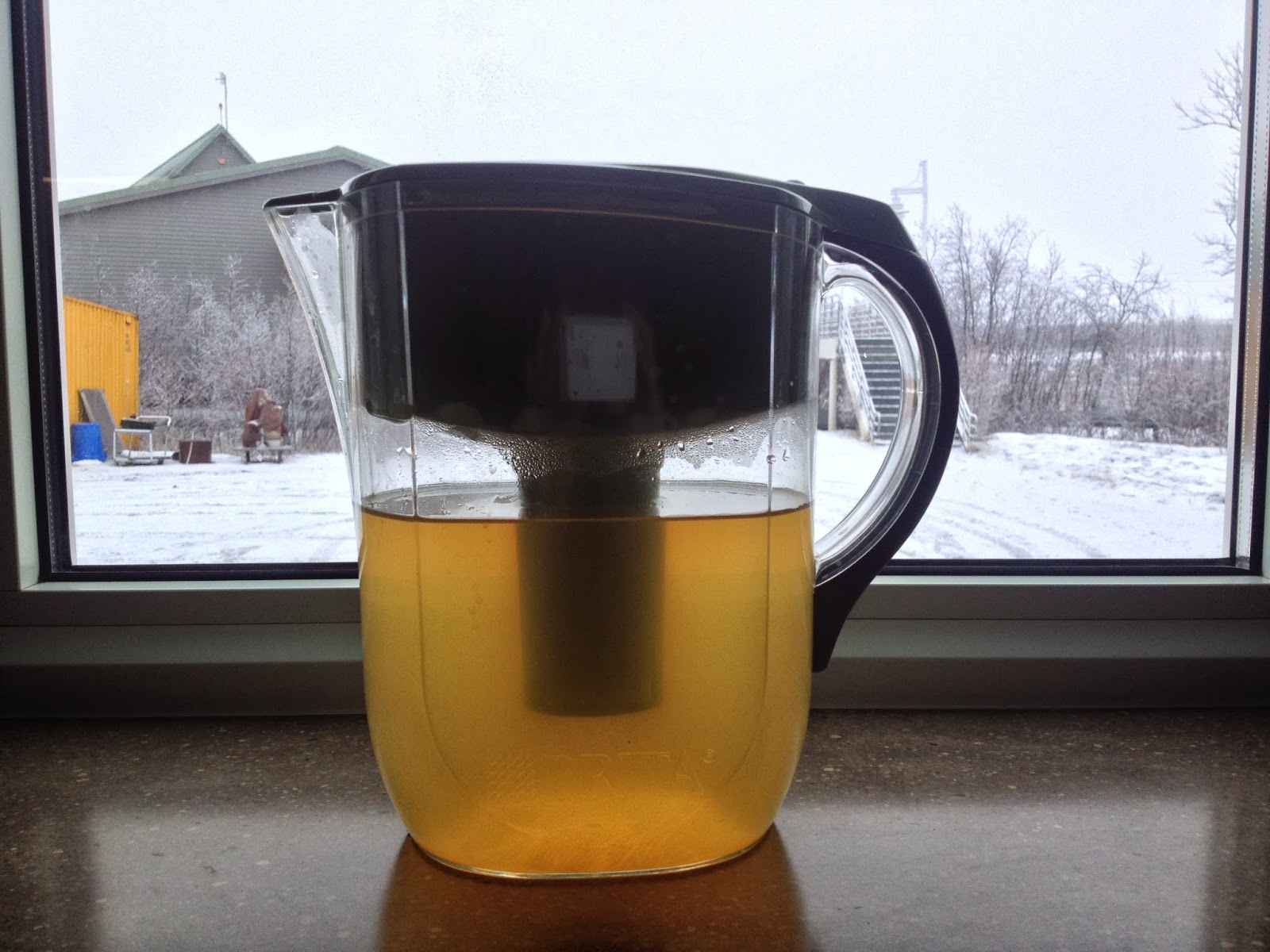
On Saturday morning, we recruited additional participants for our study. We decided it would be a good idea to make some coffee for ourselves and the childrens' parents. After filling the clinic Brita with tap water, we noticed the water had an interesting color. The coffee tasted fine, but it is easy to understand why parents might be hesitant about giving their children tap water. In fact, some parents have talked to us about the concerns they have with Bethel tap water. Bethel's community water supply is fluoridated, but it would be interesting to know what percentage of the population drinks the water.


Before work on Saturday, we stopped by the Bethel Farmer's Market, located in a one-room building near large greenhouses in which Tim Meyers (the farmer) grows food all year round.


The market sells produce that is flown in as well as locally grown fruits and vegetables. Currently, Tim sells root vegetables grown in his winter greenhouses.


Before coming up to the YK Delta, I packed most of my food into a large cooler. This is the norm for visitors before heading out to villages for dental trips. There are no restaurants in the villages. I did go to the local grocery store in Bethel a couple times, one of which is called the AC.


Prices at the AC are high because all the food sold is flown in from Anchorage. I took a photo of a circular advertisement, which provides insight as to how much food costs in the YK Delta.


Since I've been taking cabs to most places within Bethel, there is a constant need to have a wallet full of cash. I came to town with a little over $100 in cash. There is a Wells Fargo in town located next to the AC.


This was what I encountered during my failed attempt to access the Wells Fargo ATM on a Sunday afternoon. So close yet so far. I'll have to try again during business hours.


Saturday, February 01, 2014

A Beautiful Dentist Visits the White House

A gift from a patient. The heading says it all. Is my hair really that long?


My UAF Co-Investigator is staying at the White House Bed and Breakfast, a typical Alaskan structure constructed of logs that were floated down the Yukon or Kuskokwim River in the 1970s. Fran, the owner, is a long-time resident of Bethel. The inside of the B&B is charming, clean, and comfortable. It's what comes to mind when I think of Alaska.


Thursday, January 30, 2014

Yurts and Rudabaga

After work, one of the dentists in Bethel hosted a party in her very cool yurt-like structure, located next to the White House Bed and Breakfast. It's a very cool structure with a living room and kitchen on the ground floor and a bedroom in the loft.


The YKHC dentists and our study team enjoyed a gourmet potluck consisting of salmon (cooked two ways), two colorful salads, homemade baked bread and butter, and an amazing coconut rice (the last of which I somehow managed not to get a photo of…you can see part of the red bowl in which it was served). What a beautiful spread of amazing food. YUM!


I met and socialized with Baga (short for Rutabaga), a vivacious and affectionate female Husky from the YK Delta. She French kissed me three seconds after I walked into the house. You can't tell from the photo but Baga has a long juicy tongue.


The YKHC dentists have built a strong sense of community, which I really enjoy being part of each time I visit Bethel. They warmly welcome all visitors into their homes and lives. The gatherings remind me of what college was like – frequent social events that happen spontaneously without an ounce of  planning stress. I've had lots of really interesting conversations with authentic, genuine people. They call it the Bethel Family and I certainly feel like an honorary member. See if you can spot Baga. There she is!


We had another great enrollment day - 7 children - bringing our total enrollment to 18 participants. I’m getting used to my operatory in the YKHC dental clinic, which is spacious and set up nicely for participant examinations and data collection.